of Niqab
- Nov 14, 2015
- 7 min read
A Holistic & Balanced Perspective on Niqab
Until today, scholars have yet to agree on one prescription with regards to covering the face or wearing the niqab.
View A
Niqab is legally binding on the woman- she who abandons it is a sinner. It says that the woman's face is definitely part of the `Aurah and she is ordered not to reveal to non-relatives.
View B
Niqab is simply recommended and encourages the woman to cover her face; however, it is not mandatory- she who abandons it is not a sinner as long as in doing so, she has not applied facial make-up that adorns her beauty.
The dispute continues between the two viewpoints and takes, on certain occasions, bitter aspects. The advocates for making the face veil mandatory accuses the other group of following their own desires. While the other group accuses their opponents with being obstinate fanatics. The matter is much broader than this and does not require accusations of obstinance or of following the desires but rather requires reaching Ijtihad (judgement based on the Shari'ah) and following Dalil (proof from the Shari'ah) to the best of one's ability.
To give the benefit of the doubt in such a situation is better and most befitting for the Muslim, limiting the points of difference and narrowing the gap of disagreement are two factors which are sought after. Thereby, we may adopt them and work on spreading them. As for the point of disagreement-it will remain under the category of Ijtihad whose advocate will be rewarded whether he attains truth or was mistaken.
First: Since the two views agree upon the legitimacy of the Niqab, that it is a consummate perfection for a woman and more virtuous for her, as well as closer to the aims of the Shari'ah-which is to prevent Fitnah, and is an obstruction to excuses as well as severing the path of those who follow their lusts, it is therefore more appropriate, that the efforts should be directed to encourage wearing the Niqab, and to motivate people towards it. And to show and explain it's virtues and merits. This implies that covering the face with the Niqab should be the general rule and uncovering the face the exception.
Second: In spite of the fact that there are differing views on the Islamic ruling regarding whether the Niqab is obligatory or recommended, it is undoubtedly one's duty to unify the call for it and cooperate as much as possible in urging young women about its necessity and to limit their desire to expose their faces as much as possible. Indeed, it is merely gracious according to both parties. Not as is happening now between opposing sides which is to leave the matter loose and dangling, through the claim that the Niqab is only Mustahab, and being aloof from spreading the call for it. This is indeed an inversion of the truth and poor judgement in the matter.
This topic, of whether women need to cover the face or can leave it uncovered, has evidence on both sides of the argument. So long as evidence from the Quran and Sunnah exists for an opinion, one must refrain from falling into the devil's trap of involving oneself in debate over it. It would be much more useful to talk about Allah (subhana wa ta'ala) and the Hereafter to the Kuffar (disbelievers) or Fasiqoon (those acting in clear contradiction to what is well known to be a part of Islam, such as avoiding alcohol).
So, whether agreeing that niqab is required or not, one must surely acknowledge that it is a desirous sign of piety, an attempt to strive for Allah’s Pleasure & Mercy, but not a compulsory command of Allah s.w.t or compulsory teachings of the Prophet s.a.w. What better example to follow for a muslimah than that of the Prophet s.a.w.’s wives. A woman does not have to wear a niqab (affixed veil), but she should emulate the female companions by using her hijab or other items, to lift and cover her face when a non-mahram man approaches, even during ihram (hajj), as this is in accordance with the practice recorded in the time of Rasullulah s.a.w.
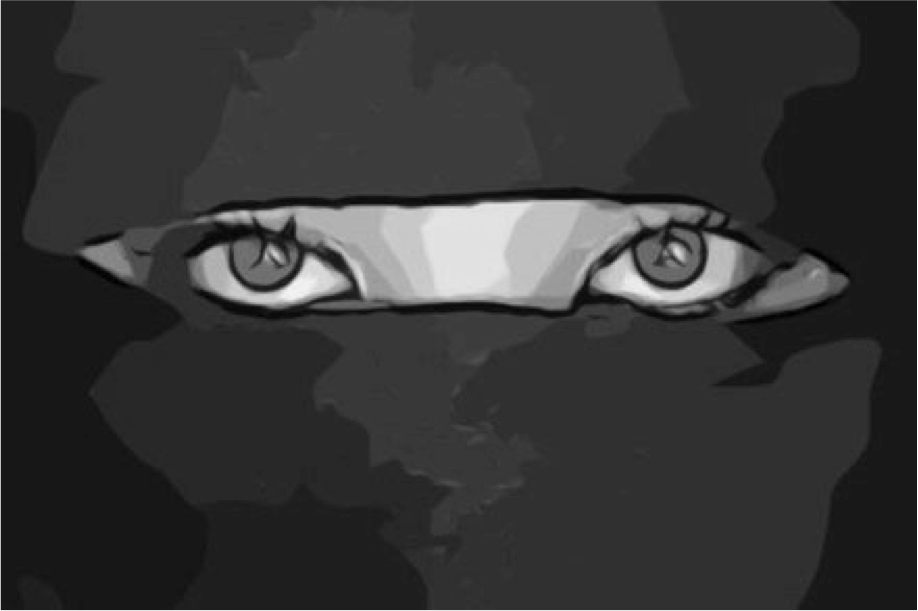
Proof from commentaries in Quranic Tafseer
(1) Tafseer - Ibn Katheer
"Allah commanded the muslim women to cover this sheet on top of them to cover their bodies except one eye, when it is necessary for them to come out of their homes."
(2)Tafseer - Commentary by Ibn Jarir and Ahkam-ul-Quran, Vol.III, p.457
Imam Muhammad bin Sirin said: "When I asked Ubaida bin Sufyan bin al-Harith (ra) the meaning of this verse and how the jalbaab was to worn, he demonstrated it to me by pulling a sheet of cloth over his head to cover his entire body, leaving the left eye uncovered. This was also the explanation of the word 'Alaihinna in this verse"
(3) Tafseer - Alu'si, Rul-ul-Ma'ani, Vol. 22, p. 89
"Ibn Jarir Tabari and Ibn Al-Mundhir described the method of wearing the jalbaab according to Ibn Abbas (ra) and Qatadah (ra). The sheet should be wrapped around from the top, covering the forehead, then bringing one side of the sheet to cover the face below the eyes so that most of the face and the upper body is covered. This will leave both eyes uncovered (which is allowed in necessity).
Proof from collections of Ahadeeth
On covering face:
(1) Yahya related to me from Malik from Hisham ibn Urwa that Fatima bint al-Mundhir said, "We used to veil our faces when we were in ihram in the company of Asma bint Abi Bakr as-Siddiq." [Muwatta Malik]
(2) It was narrated that Asma’ bint Abi Bakr said: We used to cover our faces in front of men. Narrated by Ibn Khuzaymah, 4/203; al-Haakim, 1/624. He classed it as saheeh and al-Dhahabi agreed with him. It was also classed as saheeh by al-Albaani in Jilbaab al-Mar’ah al-Muslimah, due to Hadith #1 & #3.
(3) Narrated 'Aisha (RA) who said, "The riders would pass us while we were with the Messenger of Allah swt). When they got close to us, we would draw our outer cloak from our heads over our faces. When they passed by, we would uncover our faces. [Narrated by Abu Dawood, 1833; Ibn Maajah, 2935; classed as saheeh by Ibn Khuzaymah (4,203) and by al-Albaani in Kitaab Jilbaab al-Mar’ah al-Muslimah.]
(4) Narrated 'Aisha (RA) who said "A woman in a state of Ihram (during Hajj and Umrah) should stretch her head - cloth over to her face to hide it." [Ahmad, Abu Dawud, ibn Majah]
(5) It was narrated from ‘A’ishah that the wives of the Prophet (peace and blessings of Allaah be upon him) used to go out at night to al-Manaasi’ (well known places in the direction of al-Baqee’) to relieve themselves and ‘Umar used to say to the Prophet (peace and blessings of Allaah be upon him), “Let your wives be veiled.” But the Messenger of Allaah (peace and blessings of Allaah be upon him) did not do that. Then one night Sawdah bint Zam’ah, the wife of the Prophet (peace and blessings of Allaah be upon him), went out at ‘Isha’ time and she was a tall woman. ‘Umar called out to her: “We have recognized you, O Sawdah!” hoping that hijab would be revealed, then Allaah revealed the verse of hijab. [Narrated by al-Bukhaari, 146; Muslim, 2170]
(6) It was narrated from ‘Urwah that ‘Aa’ishah said: The Messenger of Allaah (peace and blessings of Allaah be upon him) used to pray Fajr and the believing women would attend (the prayer) with him, wrapped in their aprons, then they would go back to their houses and no one would recognize them. [Narrated by al-Bukhaari, 365; Muslim, 645]
(7) It was narrated that `Aishah (RAA) said: "Asmaa' the daughter of Abu Bakr (RAA) came to see the Messenger of Allah (SAAWS) wearing a thin dress; so Allah's Messenger (SAAWS) turned away from her and said: O Asmaa', once a woman reaches the age of menstruation, no part of her body should be seen but this-and he pointed to his face and hands. (Sunan Abi Dawud)
This hadith is found only in the hadith collection of Abu Dawud (no. 32:4095). According to Abu Dawud, it is considered weak because the narrator who transmitted it from Aisha is not known (mursal).
There is no link between Ayeshah (Radhiallaahu Ánha) and Khalid bin Dareek, who narrated the hadith from her. And in every chain of narrators Khalid bin Dareek is mentioned.
In the chain of narrators Sa'eed bin Basheer appears, who is known by most of the Muhaditheen as being a weak narrator.
This has been mentioned by Imaam Ahmad bin Hanbal (Rahimahullah), An-Nasai (Rahimahullah), Ibn Madeeni (Rahimahullah) and Ibn Ma'een (Rahimahullah). This is also why Imaam Bukhari (Rahimahullah) and Muslim (Rahimahullah) did not except this hadeeth to be in their books. (From Shaikh Ibn Uthaymeen in the book "Hijaab" pages # 17 and 18.)
We also have to see that the Muhadith Abu Dawood when he quoted this hadeeth put with it that it is Mursal (with a broken chain that does not lead up to the Sahabah).
(From The Book "Hijaab wa Safur" under the fatwaa of Shaikh Abdul Aziz Bin Bazz on Page #61. Also stated as being weak by Shaikh Nasiruddeen Al-Albaani in his Daeef Sunan Abu Dawud in Kitab-ul-Libas under hadeeth number 4092 (which is the original hadeeth number.)
An other thing that shows the weakness of this hadith is that after the ayah for hijab (Surah Al-Ahzaab – Verse #59) was revealed then the women of Sahaba wore a complete veil and covered the faces and hands. This includes Asmaa (Radhiallaahu Ánha) the daughter of Abu Bakr, who is supposed to have narrated this hadeeth. Asmaa (Radhiallaahu Ánha) covered herself completely including the face, this has been narrated in authentic hadeeth in Imaam Malik's "MUWATTA Book 20 Hadeeth # 20.5.16."
On (un)covering face:
(1) ‘Abd Allaah bin Umar said that he heard the Apostle of Allaah(ﷺ) prohibiting women in the sacred state (wearing ihram) to wear gloves, veil(their faces) and to wear clothes with dye of waras or saffron on them. But afterwards they can wear any kind of clothing they like dyed yellow or silk or jewelry or trousers or shirts or shoes. Abu Dawud said ‘Abdah and Muhammad bin Ishaq narrated this tradition from Muhammad bin Ishaq up to the words “And to wear clothes with dye of waras or saffron on them”. They did not mention the words after them.
It has also been authentically related in Sahih Al-Bukhari, the Muwatta of Imam Malik and the Sunan of Abu Dawood that the Prophet (SAAWS) forbade women from covering their faces and hands during their perfomance of Salat, or while in a state of Ihram. This indicates clearly that wearing the face veil (Niqab or Burqa'a) was a common practice during the time of the Messenger of Allah (SAAWS), and not as some people claim, a cultural practice that appeared years later.
(a) The Messenger of Allah forbade women from covering their faces when in ihram or prayer.
(b) The citing of the covering of the face and hands may be an observed customary practice. There is no clear indication that covering the face and hands are mandatory upon the believing women.


Comments